Bellevue topography and microclimates create severe subterranean moisture stress across residential foundations. Homes located along high-water-table corridors near King County drainage zones, such as the peat soils in…
Bellevue topography and microclimates create severe subterranean moisture stress across residential foundations. Homes located along high-water-table corridors near King County drainage zones, such as the peat soils in Mercer Slough Nature Park, lakefront footings along Newport Shores, and wet clay hillside slopes across Lakemont and Somerset, frequently draw ground evaporation directly upward into subflooring. When relative humidity levels in an unconditioned under-floor space consistently surpass 70 percent, foundation timbers absorb ambient vapor, creating an ideal habitat for wood-decay fungi and subterranean organisms. According to the United States Environmental Protection Agency, sub-slab soil gases and biological particulates travel upward via the stack effect, meaning up to 50 percent of the air breathed on the first floor originates inside the crawlspace. Unsealed soil permits damp conditions where Washington State Department of Agriculture monitored structural pests like dampwood termites, carpenter ants, and moisture ants establish colonies. Routine pesticide applications alone fail to resolve these infestations because ambient dampness continuously neutralizes bait matrices and dilutes surface barriers.
Comprehensive restoration addresses biological vector risks directly. When rodents discover warm foundation voids beneath neighborhoods such as West Lake Sammamish or Bridle Trails, they deposit pheromone trails, urine streams, and droppings across fiberglass subfloor batts. The Centers for Disease Control and Prevention documents that aerosolized rodent excreta presents measurable respiratory hazards to building occupants. Field technicians executing crawlspace sanitation utilize specialized HEPA-filtered negative-air units operating under standards outlined by the Institute of Inspection Cleaning and Restoration Certification. All soiled batts, rodent carcasses, and nest debris undergo direct removal into sealed disposal containers. Technicians apply non-corrosive, EPA-registered bio-enzymatic antimicrobials meeting Occupational Safety and Health Administration jobsite environmental standards onto joists, sill plates, and subfloor sheathing. This application digests lingering pheromone proteins that attract future rodent migrations without off-gassing synthetic volatile organic compounds into living quarters above.
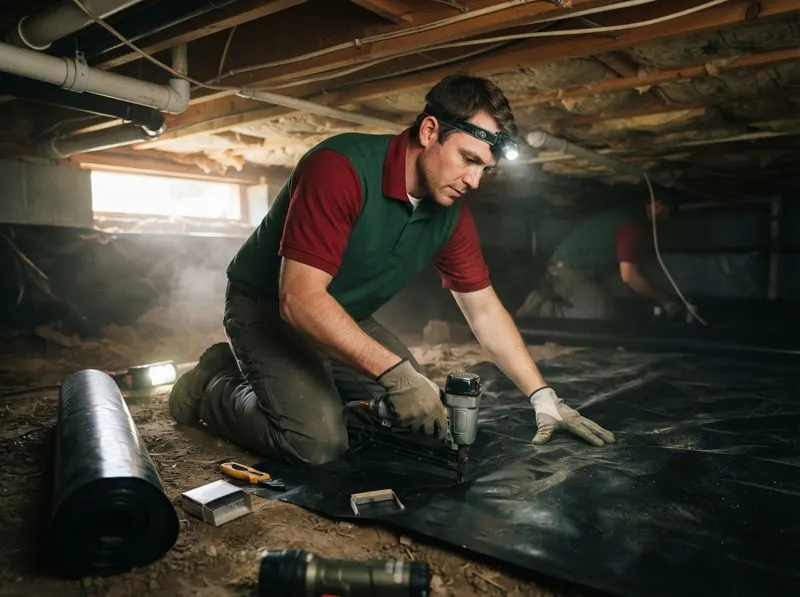
Vapor barrier defense establishes permanent physical isolation between damp earth and structural wood. Building envelopes constructed around Factoria, Wilburton, and Enatai often rely on degraded 4-mil polyethylene sheets that tear easily, pool standing condensate, or shift out of position. Standard protocol replaces damaged materials with reinforced, cross-laminated 10-mil to 20-mil virgin poly sheeting complying with ASTM International E1745 vapor retarder performance criteria. Technicians overlap all sheet seams by a minimum of 12 inches, securing joints with specialized high-tack butyl seam tape, and mechanically fasten the polyethylene 6 inches up concrete stem walls using masonry anchors. Foundation wall penetrations around plumbing waste lines and electrical conduits receive expanding elastomeric foam seals in accordance with U.S. Department of Energy crawlspace envelope guidelines. Foundation vent screens are fortified with corrosion-resistant 1/4-inch galvanized steel hardware cloth compliant with the U.S. Department of Housing and Urban Development residential moisture and vector control directives. This mechanical barrier blocks burrowing rodents while maintaining passive airflow balance or pairing with closed encapsulation dehumidifiers when interior relative humidity requires continuous suppression below 55 percent.
Every job gets a firm, written price after a free on-site visit.
For standards, safe disposal, and service guidance on PEST CONTROL SEVICE in Bellevue, WA, useful references include U.S. EPA, ENERGY STAR, U.S. Dept. of Energy, Consumer.gov, U.S. Census Bureau, and Google Maps. General consumer and small-business resources are available from USA.gov, Better Business Bureau, FTC Consumer Advice, U.S. Small Business Administration, and Ready.gov.
Tell us about your crawlspace sanitation & vapor defense job in Bellevue and we'll send a clear, written quote, usually the same day.
 Redwood Bug Services